|
Urban Infrastructure under severe strain
The Summit on Sustainable Private-Public Partnerships in Integrated Infrastructure (SUMINFRA 2004) organized by the Confederation of Indian Industry (CII) was held between the 2nd and 3rd of September 2004 in Bangalore. The event was hosted by the Government of Karnataka at the Leela Palace.
The inaugural session on Urban Competence, held on the second day drove home the theme of the summit – Creating Sustainable Frameworks for Public-Private Partnerships (PPP) in Urban Infrastructure to the delegates which included urban planners, entrepreneurs and financial institutions.
In his keynote address, Mr. A. Ramakrishna, Deputy Managing Director, Larsen & Toubro ECC Division, said, “Twenty-eight percent of India’s one billion population that live in urban areas, is growing at 31 percent compared to a growth of 17 percent in rural India. And this puts urban infrastructure under tremendous strain. For this we need an investment of over Rs 400,000 crores1 (CAD 1.095 trillion2) in water supply, sanitation and transport in the next 20 years.”
In the current scenario, legislature does not encourage the private sector to participate in developing urban infrastructure, said Mr. Ramakrishna, though the Central Government is developing guidelines for the involvement of the private sector. One initiative has been the opening up of Foreign Direct Investment in urban infrastructure.
This participation is needed especially in the development of urban transport for a good network of roads which will have adequate capacity. “The perspective on road development needs to be changed – from addressing connectivity to ensuring mobility, from short reach improvements to corridor developments. Even road maintenance contracts must be given to private parties,” commented Mr. Ramakrishna. He added that it is important to provide duct facilities so that cables can be laid without cutting across roads.
Mr. Ramakrishna cited successful projects such as the Mumbai-Pune Expressway, a 94-km stretch of a six-lane concrete road, with five major bridges and one which was completed in 27 months at an outlay of Rs 1600 crores (CAD 438.25 million). The 265-km Sirsi Circle Flyover in Bangalore’s traffic congested commercial area is another example that shows how segmented construction can be used for speedy building, without disturbing traffic. In Chennai, the 25 km Elevated Expressway from Seaport to Airport is yet another case in point of PPP.
With civil aviation traffic on the increase, Mr. Ramakrishna felt that there was an immediate need to redesign existing airports, besides constructing new airports. He said, “By 2005, there will be 60 million passengers and 1.5 million tons of cargo to be air freighted.” On Port Development, Mr. Ramakrishna opined that the private sector could participate in the development of minor ports. The open sea jetty at Ratnagiri and the Bharati Dock at Chennai were two successful ventures.
With regard to Housing, there will be a need for 250 million units in the next 10 years. Mr. Ramakrishna said that the government should provide the land to enable PPP ventures to accelerate housing development.
Are we using the infrastructure to the fullest? Are the different government boards geared to provide service?” asked Mr. Subir Hari Singh, IAS, Principal Secretary, Housing Department, Government of Karnataka. He called on authorities to “look at urban areas as generators of wealth.” Bangalore Action Task Force, he said, was a bold initiative to frame the agenda for the city.
Mr. Singh stated that the most important urban concern was the slums, which had no access to civic amenities. “Relocating them has not been a success,” he said. Low cost housing is probably one area where the private sector can collaborate with the government.
Mr. J.P. Nayak, Chairman, SUMINFRA 2004, and President (Operations) Larsen & Toubro, gave statistics generated from a study of people living in the urban areas. Ninety percent of the urban population is not happy with roads; 48 percent find roads unsafe; 91 percent say that pollution levels are high; 60 percent felt that public transport was not good and 80 percent wanted an improvement in water supply. “There needs to be a change in approach by the government – from that of provider to facilitator of private participation.”
In his concluding remarks, Mr. Ajit Advani, Chairman, Working Group-Urban Competence, CII (SR) & Executive Vice President, Siemens Ltd., said, “The Government, entrepreneurs, financial institutions and users must all have a win-win approach for PPPs to be sustainable”.
|
Speaking on Infrastructure
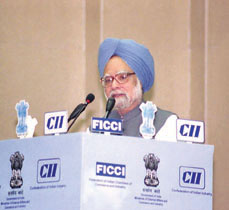 “We believe that the Indian economy can absorb up to US$150 billion of foreign investment in the infrastructure sector over the next 10 years. We are working towards creation of a regulatory framework in infrastructure sectors that will be transparent and independent, and based on international best practices.”
“Airports and railways require US$55 billion over the next 10 years, whereas the power and telecom sectors need US$75 billion respectively over five years.”
Prime Minister Manmohan Singh
While addressing the ASEAN Regional Business Summit in September 2004
|
|
|
|