|
Canada occupies the northern portion of North America touching the
Atlantic, Pacific and Arctic Oceans. Canada is a land of lakes,
rivers, mountains, plains and forests. Canada is a melting pot of
cultures with two official languages – English and French –
but many other languages are spoken. If you like diversity, then
Canada is for you.
 Thousands of years ago Aboriginal people are believed to have
crossed a land bridge between Siberia and Alaska into North
America, some settling in Canada. Norsemen arrived in Canada
around 1000 years ago and settled briefly in Newfoundland. Then
came the French and British exploration, settlement and fight for
dominance. French Canada fell to the British in 1759, but French
settlers maintained their culture, language and traditions which
is still heavily part of the Canadian culture today. Colonists
loyal to the British Empire fled the United States of America in
1776 when independence was declared and settled in Canada. On the
1st of July 1867, Quebec, Ontario, Nova Scotia and New Brunswick
joined together to create a new country. Other provinces followed
suit in the years to come.
Thousands of years ago Aboriginal people are believed to have
crossed a land bridge between Siberia and Alaska into North
America, some settling in Canada. Norsemen arrived in Canada
around 1000 years ago and settled briefly in Newfoundland. Then
came the French and British exploration, settlement and fight for
dominance. French Canada fell to the British in 1759, but French
settlers maintained their culture, language and traditions which
is still heavily part of the Canadian culture today. Colonists
loyal to the British Empire fled the United States of America in
1776 when independence was declared and settled in Canada. On the
1st of July 1867, Quebec, Ontario, Nova Scotia and New Brunswick
joined together to create a new country. Other provinces followed
suit in the years to come.
Canada, with a total area of 9,984,670 square kilometres, is the
world’s second largest country after Russia. It is thinly
populated, however, with much of the land too cold or too
mountainous for human settlement. Most Canadians live within 300
kilometres (186 miles) of the southern border.
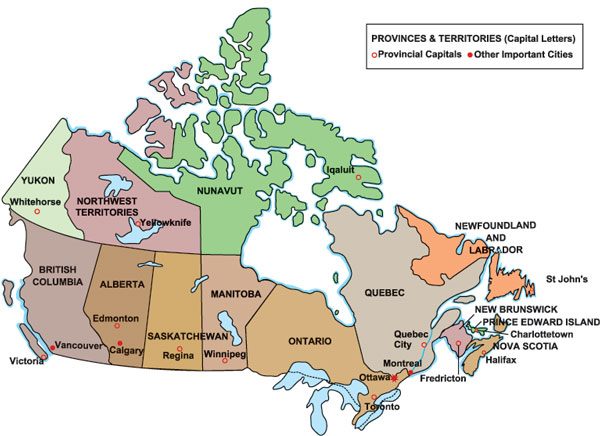
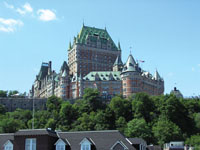 Much
of Canada is wilderness, being covered by forest. The terrain of
the far north consisting of the North West Territories and Nunavut
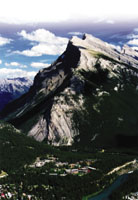
Territory is mostly frozen tundra. The Rocky Mountains cover a
major part of western Canada – British
Columbia, the Yukon Territory, and the western part of
Alberta. West-central Canada,
where the eastern part of Alberta and the provinces of
Saskatchewan and Manitoba are located, is mostly prairie
consisting of large grain farms. To the north lies the frozen
tundra of Nunavut Territory
and the Northwest Territories. The provinces of
Ontario and
Quebec make up the east-central part of Canada. These consist of
vast forested wildernesses with hundreds of lakes in their
northern reaches, and major population and industrial areas in the
south. The Atlantic Provinces – New
Brunswick, Nova Scotia,
Prince Edward Island and Newfoundland – consist of woodland,
farmland, rocky coves and sandy beaches of the Atlantic Ocean and
the Gulf of St Lawrence. Much
of Canada is wilderness, being covered by forest. The terrain of
the far north consisting of the North West Territories and Nunavut
Territory is mostly frozen tundra. The Rocky Mountains cover a
major part of western Canada – British
Columbia, the Yukon Territory, and the western part of
Alberta. West-central Canada,
where the eastern part of Alberta and the provinces of
Saskatchewan and Manitoba are located, is mostly prairie
consisting of large grain farms. To the north lies the frozen
tundra of Nunavut Territory
and the Northwest Territories. The provinces of
Ontario and
Quebec make up the east-central part of Canada. These consist of
vast forested wildernesses with hundreds of lakes in their
northern reaches, and major population and industrial areas in the
south. The Atlantic Provinces – New
Brunswick, Nova Scotia,
Prince Edward Island and Newfoundland – consist of woodland,
farmland, rocky coves and sandy beaches of the Atlantic Ocean and
the Gulf of St Lawrence.
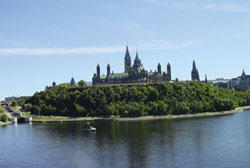 Canada’s
climate varies. In winter, temperatures fall below the freezing
point throughout most of the country. But the south-western coast
has a relatively mild climate. Along the Arctic Circle, mean
temperatures are below freezing for seven months a year. During
the summer months the southern provinces often experience high
levels of humidity and temperatures that regularly surpass 30
degrees Celsius. Western and south-eastern Canada experience high
rainfall, but the Prairies are relatively dry. Canada’s
climate varies. In winter, temperatures fall below the freezing
point throughout most of the country. But the south-western coast
has a relatively mild climate. Along the Arctic Circle, mean
temperatures are below freezing for seven months a year. During
the summer months the southern provinces often experience high
levels of humidity and temperatures that regularly surpass 30
degrees Celsius. Western and south-eastern Canada experience high
rainfall, but the Prairies are relatively dry.
Canada has a widely spread population of 32,507,874. Almost 35
percent of Canadians are of British descent; 20 percent are French
and Italian; Chinese, Ukranian, Dutch, Greek, Polish, Indian and
Scandinavian make up a large portion of the population. The
aboriginal people – 470,000 Native Indians and 32,000 Inuit –
are much fewer in number than when the Europeans came. There are
also approximately 450,000 Metis, the name used to denote those of
mixed aboriginal and European blood. All together these groups
account for around 4 percent of the population. Inuits is the
preferred name of the Eskimos of Canada. Seventy percent of the
Canada’s Native Peoples live on the 2250 reserves set aside for
Native peoples.
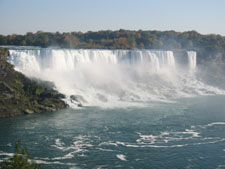 Education in Canada is free from elementary through to secondary
school and falls under provincial government jurisdiction.
Colleges and Universities must be paid for after secondary school.
French immersion programmes are popular throughout Canada where
English-speaking children are taught all their courses in French
during secondary school.
Education in Canada is free from elementary through to secondary
school and falls under provincial government jurisdiction.
Colleges and Universities must be paid for after secondary school.
French immersion programmes are popular throughout Canada where
English-speaking children are taught all their courses in French
during secondary school.
Canada is a highly developed and prosperous country. Although
farmland covers only 8 percent of the country, Canadian farms are
highly productive. Canada is one of the world’s leading
producers of barley, wheat, meat and milk. Forestry and fishing
are other important industries. Canada is rich in natural
resources, especially oil and natural gas, and is a major exporter
of minerals. The country also produces copper, gold, iron ore,
uranium, and zinc. Manufacturing is highly developed, especially
in the cities where 78 percent of the people live. Canada has many
factories that process farm and mineral products. It also
produces, cars, chemicals, electronic goods, machinery, paper and
timber products.
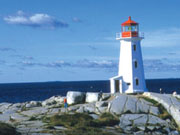 Canada’s system of government was originally based on the
British system and now operates as a federal multiparty
constitutional monarchy. A Federal government oversees and acts on
matters of national interest. Provincial governments operate with
their own ability to legislate on provincial matters.
Canada’s system of government was originally based on the
British system and now operates as a federal multiparty
constitutional monarchy. A Federal government oversees and acts on
matters of national interest. Provincial governments operate with
their own ability to legislate on provincial matters.
The head of state is H.M. Queen Elizabeth II with a Governor General
appointed as the Commonwealth’s representative in Canada.
Ottawa, on the south bank of the Ottawa River, is the Nation’s
Capital.
|