|

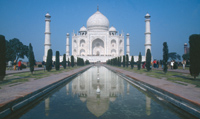 India is a country as large as a sub- continent. India is a land of rivers, mountains, deserts, islands, plain lands and of many different ethnic groups. India is a country of dozens of languages and hundreds of dialects and cultures. If you wish to see a mini-world with your own eyes, welcome to India.
India’s history dates back to 3000 BC and beyond. The Indus Valley civilization, one of the world’s greatest ancient civilizations, flourished here. The history of the country is a fascinating story of kingdoms and empires and their rise and fall. Chandragupta Maurya (322-298 B.C.), was one of India’s greatest emperors.
 The Mauryan reign peaked under emperor Ashoka the Great, who was not only a great ruler, but one of the most successful propagators of Buddhism in India and outside. Unlike the North of India, foreign invasions had relatively little impact on life in South India, which also saw the rise and decline of many empires. These included the
Cholas, the Pandyas, the Cheras, the Pallavas and the Chalukyas, followed by the Hoysala and the Vijaynagar empires.
The Mauryan reign peaked under emperor Ashoka the Great, who was not only a great ruler, but one of the most successful propagators of Buddhism in India and outside. Unlike the North of India, foreign invasions had relatively little impact on life in South India, which also saw the rise and decline of many empires. These included the
Cholas, the Pandyas, the Cheras, the Pallavas and the Chalukyas, followed by the Hoysala and the Vijaynagar empires.
India is the seventh largest country in the world with a total land area of 3.3 million square kilometers. In the North are the towering Himalayas, which slope out into the great
Indo-Gangetic plains. On the east coast of the country is the Bay of Bengal; while on the west coast is the Arabian Sea. The southern-most tip of the country projects into the Indian Ocean.
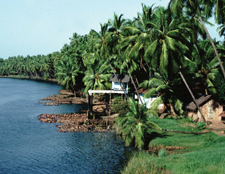
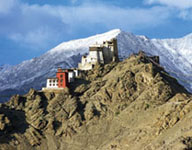 The variety of geography has always been an attraction of this country. Where else can one find plateau, desert, plain land, coastal patches, marshlands, delta, and islands, all together? You have here the widest possible variety of flora, fauna and climate. Seasons that range from tropical to arctic. If travelers and tourists are left spellbound, blame not man but nature’s gift to India.
The Deccan plateau is the oldest portion of India and was part of the single landmass comprising South America, Africa, Australia and Antarctica. The
Indo-Gangetic plain in the north is formed by the basins of three great rivers, the Indus, the Ganges and the
Brahmaputra. In the West of the country lies the Thar Desert in
Rajasthan.
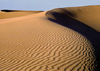 A little south of it are the unique marshlands of Kutch, while on the east where the Ganges drains out into the sea is the world’s largest delta, the Sunderban delta, and a unique mangrove forest. Indian islands include the Andaman and Nicobar in the Bay of Bengal and the Lakshadweep Islands in the Indian Ocean.
 India’s climate varies from region to region. The North enjoys a cold weather in the winter months between November and March. The coastal areas have a tropical climate throughout the year, while the plains and most central and southern regions of the country are hot in the summer months of April and June. Most of the country has a vigorous monsoon, which lasts from July to October. India’s climate varies from region to region. The North enjoys a cold weather in the winter months between November and March. The coastal areas have a tropical climate throughout the year, while the plains and most central and southern regions of the country are hot in the summer months of April and June. Most of the country has a vigorous monsoon, which lasts from July to October.
India is one of the most culturally, linguistically, and ethnically diverse regions one can imagine. Four major peoples, distinguished by the languages they speak, make up the population of the region. The majority of the population is Indo-European, speaking a variety of languages related to European languages, such as, Greek, German, and English. The bulk of Indian religions and almost all of its literature is Indo-European. Second to the Indo-Europeans, but more ancient in India than the later immigrants, are a people who speak languages from the Dravidian family of languages. In addition, the peoples in the northern mountains speak languages related to Chinese, Tibetan, or Mongolian. Finally, the smallest group, but most likely the oldest inhabitants of India, speaks languages from the Australoid families, which are the languages spoken by indigenous peoples scattered throughout Southeast Asia and Australia. Each of these groups speaks a bewildering variety of languages; a single language dominates each region of India.
 India’s internal diversity is fully replicated in its border demarcations with its
neighbours. Located in the northern hemisphere, India shares its borders with Pakistan, Afghanistan, China, Nepal, Bhutan, Myanmar and Bangladesh. The rest of the land is surrounded by sea. India’s internal diversity is fully replicated in its border demarcations with its
neighbours. Located in the northern hemisphere, India shares its borders with Pakistan, Afghanistan, China, Nepal, Bhutan, Myanmar and Bangladesh. The rest of the land is surrounded by sea.
A new spirit of economic freedom is now stirring in the country, bringing sweeping changes in its wake. A series of ambitious economic reforms aimed at deregulating the country and stimulating foreign investment has moved India firmly into the front ranks of the rapidly growing Asia Pacific region and unleashed the latent strengths of a complex and rapidly changing nation.
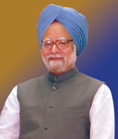
Now when India has a renowned economist like Dr Manmohan Singh as Prime Minister, and Finance Minister Mr P Chidambaram at the helm, the economy of the country is likely to become much more robust and there is every reason to be optimistic about the future.
|